
Taken from an article in ‘Traditional Karate’ July 1988
Daniel in the dragon’s den
Danny Connor tells of his life and times to Bey Logan in an exclusive, in-depth cross-magazine interview.
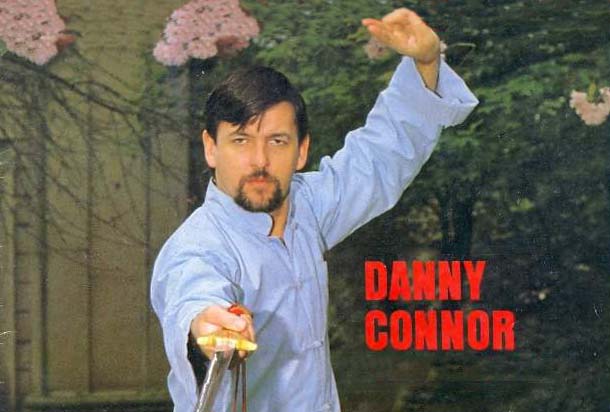
There can be precious few areas of the martial arts in which Danny Connor has not been involved. In a long and illustrious career, he has been a student, teacher, club owner, retailer, traveller, politician and entrepreneur. From his early years in Shotokan, and in tournament karate, he moved through Wado Ryu to Tai Chi to Wing Chun to finally, (he says) Chi Kung. It’s at this point in his career, when Danny says he will be less involved with his other interests and more active in the promotion of Chi Kung training, through his latest protege Michael Tse, that a retrospective seems due. How can you sum up someone like Daniel Connor? When he seems vague and laid back, you know that the mousetrap fast wit is just waiting for a chance to spring. When he goes deep, talking about life, the universe and karate politics it’s usually with a dry Irish humour. When he has enthusiasm for something, be it the Wing Chun of Yip Chun or the Karate of Dominique Valera, his energy is infectious, and gives an indication of why people as disparate as Michael Tse and Alfie Lewis take him as their mentor. Whatever you think about his often controversial figure, there’s no doubting that Danny was in at the start of Karate in the UK, and is still a key figure. In this issue of ‘Traditional Karate’, we cover Connor’s involvement in the Japanese martial arts, including his three-year sojourn in Tokyo. In next month’s ‘Combat’, we look at his fascination with Tai Chi, Wing Chun and Chi Kung. Like a temporal ying and yang, these are the two sides to Danny Connor.
BEY LOGAN: Danny, can you remember your first involvement with martial arts?
DANNY CONNOR: Yes. I found a few scraps of a Jujitsu book many years ago. It talked of two Japanese standing on the top stairs of a noodle shop, strangling their opponents and throwing them down the stairs. I thought “What a wonderful occupation”
B.L: Remind me never to take you to a Japanese noodle shop.
D.C: Right! I had at that time heard of this thing called ‘Karate’ sometimes pronounced ‘Kah-Rayte’ or ‘Kar-Rat’. This was in the 50s, and I drove my folk mad with this dream I had of doing this Japanese art. Then my father saw an advert for a Karate club opening in Ashton-Under-Lyne, and so I went along to this Judo club that was called Kyushindokwai. There, Martin Stott was teaching Karate, and so, at last, I learned how to pronounce that word. The mats at the club were a series of bedspreads with sheets pulled over them. I started training there, alongside Roy Stanhope, Tony Hudson . . . This was about 1960.
B.L: What was the basic style being taught?
D.C: The basic art was that of negotiating these bed-spreads without breaking your toes! Martin was teaching Shotokan. He had studied Karate while he had been on a catering course in Paris. He had studied with a Vietnamese guy named Tham Ny Tho, and it was in a form of Shotokan.
B.L: Was there any competition scene then?
D.C: No. There were no tournaments at all. This was very early days. The first real competition was the first All-Britain Karate association event that was organised by Len Palmer, in 1965, I think. I trained at the same club for three years, and then Martin invited me to be his partner and we moved to central Manchester and opened a gym there. Now at this time, we thought that you only had to know three katas to get your black belt. They were Kata One, Kata Two and Kata Three. There were no names! Somehow we located a book called ‘What is Karate?’ by Mas Oyama, and I used to hold the book while Roy Stanhope executed the katas that were in it. However, we were game, and we weren’t put off by the lack of information. It’s something that people today probably can’t relate to.
B.L: Perhaps there’s sometimes too much available What kind of sparring did you do then?
D.C: Well, we had no idea what rules were, and so a flying Nukite was considered quite a reasonable technique to throw at somebody. As for fighting posture we were told that you could take any move from a kata and use it in that exact manner. There must have been a lot of strange stuff going on.
B.L: Did you ever feel the urge to test this Karate on the streets of Manchester?
D.C: We did see in Oyama’s book that he ripped the horns off bulls. We thought that this was quite possible. The whole thing behind Karate was that you hoped to reach super-normal powers. One of the lads came over the Pennines on his way to train and he suggested that he could bring a sheep with him and we could all take turns trying to execute it with a gyakazuki, but someone complained that the sheep might make a mess on the stairs . . so we had to settle for Tamashiweri instead.
B.L: So, lambs may safely graze. Not wanting to ram the point home, but, when you moved from the first dojo, what did you call your new, school?
D.C: At first, we didn’t have a name, but then we became involved with Mr. Tatsuo Suzuki. We went down to London, met Len Palmer and had a training class with him, and were most impressed by this high degree of enormous skill, and we signed up immediately, just to get our house in order. Mr. Suzuki named our club ‘The Sei Do Kan’, and it started to become quite popular. This was around 1965-66.
B.L: So it was simultaneous with the beginnings of organised competition karate in this country. Do you remember the first English championship?
D.C: Yes. It was a quickly hustled together affair. It was at Crystal Palace. Mr. Suzuki, Mr. Enoeda. Mr. Kanazawa . . . they all worked together to make it the first All-Britain championships.
B.L: We recently had Brian Crossley, the first champion, in Trad.’ Do you remember how you fared on the day?
D.C: Yes. In my first fight, I think Peter Spanton’s foot stuck in my stomach. In London, they were very fortunate because they had travelling Japanese instructors visiting quite often. I think Mr. Shiomitsu was in the country at that time. As a result, the Honbu in London was producing some good performers, of which Peter was one. We brought a team down from Manchester in a minibus and we were still at bit naive. We thought, for instance, that shin kicks would score! Anyway, we soon got the basic idea of the scoring, although the judges hadn’t. I suppose that came later.
B.L: Did it?
D.C: Maybe we’re still waiting! There was a lot more accidental contact back then. I think it was more spirit than skill. I think that if there had been the same quality of instruction then as there is now and the same volume of people, then the talent might have been as good. As it was, there were a lot of chipped teeth and broken noses, but that was it.
B.L: So you went out early in that event?
D.C: No. I had a few fights. Our team fought Honbu and in that fight Peter Spanton decided it early, and Brian Crossley went onto win it. We then went away for another year, figuring that it was just an annual event like the Cup Final.
B.L: Did you like tournament fighting?
D.C: I enjoyed it because it was a ‘safe’ form of combat. I’ve never been a particularly violent person. I thought it was a reasonable way to judge speed, skill and technique.
B.L: In some ways, don’t you think that the general public regarded Karate with a good deal more respect that they do now?
D.C: I think that British people always have respect for an aspect of foreign culture until they understand it. Then the attitude changes. I think that publicity afforded to martial arts over the years has shown them in a variety of different lights. At one time it had that ‘Buddhist monk’ ring to it, but that’s slowly dissolved, I think.
B.L: What was the next step for your club after that first event?
D.C: We came back in 1966 to win. We fought Tommy Morris’s team in the final. We were keen and eager. We were the young bloods.
B.L: I’ve heard from various sources that you were a pretty cagey fighter; that you made up for in sneakiness what you lacked in bulk.
D.C: I found what worked and stuck to it. There was a lot of variety to begin with, but I think that same thing happened with tournament Karate as has happened to full-contact. Full-contact came in the 70s, and started off with people doing very dramatic stuff that very quickly got narrowed down to what would work. The same thing happened in competition Karate.
B.L: So what were your basic scoring techniques for tournaments?
D.C: As far as I can recall, front kick and snap punch. Lead hand punch.
B.L: Who were the other competitors of the day who impresses you?
D.C: Ticky Donovan. He won the Junior Championship in 1966, though he never puts it in his list of accolades. He was a green belt then. He had great fighting spirit and, as history has proved, a great analytical mind for the competition arena. Another was Peter Spanton. He was shining at that time. He was meant to fight Dominique Valera in Paris. The Internationals were just starting up at this time. Mr. Suzuki had put a team together, and it was made up of Tommy Morris, Ticky Donovan, Peter Spanton, myself and there was a little Chinese guy whose name escapes me.
B.L: Tell us about Spanton versus Valera.
D.C: Peter’s star shone high quickly. He was well-gifted physically, a strong man. Valera had been over to England part of a French team, though he was only in his teens at the time. We were all in awe of him at that time, though I don’t think any of us really realised how good he really was. Anyway there we were in Paris, and Spanton was like our big hand in a poker game. Spanton versus Valera. They measured each other up, moved round and then suddenly they both exploded with punches at the same time and their fists collided in mid-air! It was an interesting way of deciding the match! Unfortunately Peter had broken his hand and had to retire from the competition. Valera went on to win, and I don’t think we ever really saw what could have been. Dominique went on to greater and greater things, and became probably the finest karate player that Europe has ever seen.
B.L: What was the general European standard like at that time?
D.C: The French dominated. They have a long martial tradition, with their savate and fencing, and they knew how to organise it. Britain came from a boxing culture, without the same experience in this kind of organised competition. The French were being coached by Yoshinao Nanbu. He had introduced the sweep, Ashi Barai, which Valera used with great skill throughout his career. The French were one unit, where we weren’t.
B.L: Were there any other members of your Manchester club who later found fame?
D.C. Well, I was in partnership with Martin Stott at the time, and Roy Stanhope who was then a bus conductor, came to work for us, and obviously went on to better things ‘We employed him for a year or so, and then I went to Japan.
B.L: What led you to make that move?
D.C: I wanted to go to where it was happening. I felt that the frisson surrounding Karate in this country was a bit artificial I wanted to go for the juice, so I went off to Japan in 1967. I got on the plane at Manchester and flew the polar route to Tokyo. I had a Karate suit in my bag and no visa. I told the immigration guy that I was a student of Mr Suzuki, not realising at that time that ‘Suzuki’ was quite a common name. Tatsuo was the only Mr. Suzuki that I knew but not the only one that the immigration officer knew. Finally, I was allowed out of the airport and I thought: “Here I am in Japan. I’m sure that they’re writing everything in English by now! ‘Sadly, no, they only had English signs in the airport.’ Despite this, I found a hotel, and then went down to Suidobashi, which was where the dojo was for the Nippon University karate club. I heard the familiar sound of Ich-Nei-San’ . . . and steam coming out of the basement windows. I thought; “How lucky I am to have found them!’ I went in and saw the students marching up and down. They were doing basics’ I thought they were moving rather slowly, but later found out that they had already been training for two and a half hours! As I came in, there was a big flap and run around, because the letter from Mr. Suzuki hadn’t arrived. There had only ever been one foreigner there previously, a German guy, so they were very interested to have a foreigner there.
B.L: What was the training like?
D.C: Grim. Four hours a day, every day. They decided, after I’d been there for a short period of time, that I should have a part-time job, and this turned out to be cleaning out the Budokan after the All-Japan Judo championships. It was a pretty horrendous task. I might have still been there now clearing up Bento (rice boxes), had I not observed that I really couldn’t do this and train as well. I couldn t cope with both activities.
B.L: How did you support yourself out there, because you stayed in Japan for three years, didn’t you?
D.C: I took some money with me, and as it began to dwindle I had to work. I taught English for a while.
B.L: The old stand by for Britons out East! How did your perception of Karate change through living and training in Japan?
D.C: It’s funny. I think you go through different stages. When you’re first there, and you’re bruised and battered and tired, you think; “When I get back to teaching in England, I’m going to make everyone suffer in the same way I have’ Hopefully, you move beyond that. I became interested in Tai Chi while I was in Japan, and began to study that while I was there.
B.L: It’s interesting how many Karate people do turn to Tai Chi, which is in many ways the total antithesis of hard style Karate to supplement their training. People like Kanazawa Sensei and Terry O’Neill have studied it, and in your case it came to supercede your karate training. Who did you study under?
D.C. It was a Chinese guy living in Japan. He had studied under Wang Shu Chin (or Jing). He was in Robert Smith’s book ‘Masters and Methods’. Bruce Frantzis and I were both training in Japan at that time. We had met in Shinjuku station, both being on our way to watch the 1967 All-Japan championships.
B.L: Did any funny experiences occur during your training in karate?
D.C. Well, one evening Mr. Furukarva’ who was the dojo manager, took me to dinner. I’d used chopsticks only once before. I had a few mouthfuls of rice and then stuck my chopsticks into my rice bowl, so that they were sticking upwards. This deathly hush fell because apparently you only put them in that way at funerals.
B.L: Ouch.
D.C. Easily done! Another time Tanabi Sensei, one of the instructors at the gym asked me if I wanted to go out and eat, what would I like . . . etc. I said: “Great! l’d love a steak!”, and was swiftlv chastised by the other students, because, when a teacher asks you what you want to eat, you must always say “Noodles” because you don’t know how much money the teacher’s got.
B.L: Another mis-steak. Did you ever have to apply your Karate in the street in the Far East?
D.C: I got into a few street fights. Not many. In that situation, I just kept punching as fast as I could . . . until they ran away. The problem with Karate in that situation is that too often Karateka expect that the first blow will do it, whereas it’s normally the ‘firstest with the mostest the fastest’.
B.L: Despite the fact that Funakoshi said that there was no ‘first strike’ in Karate!
D.C: It depends how you view ‘strike’ Do you construe a nasty look from somebody as a strike, or abusive language as an offensive action?
B.L: So what happened when you came back to England from the Far East? Had you already decided to follow a Tai Chi career?
D.C: Well, I’ve never seen myself as a teacher. I’ve always seen myself as a student,and so I’ve been able to follow the paths I’ve chosen. In that sense, I’ve been very fortunate. Many people have developed themselves through Karate, but I found that, with Karate, everyone experiences diminishing returns, in terms of ability, as they get older. So I’d really shifted interests at this point. I was teaching Tai Chi when I came back, which was quite new to this country. I think Paul Crompton was teaching some in London. I remember giving a demonstration at Crystal Palace at a Karate tournament, and everyone thought it was very weird. At that time, though, the Bruce Lee boom was on, and everyone was into ‘zip, zap’ and so Tai Chi just didn’t fit into peoples heads at that time.
B.L: Were you still involved with Karate?
D.C: Yes. I’d had some experience and some good teachers, and so Brian Smith invited me to come and teach on a national course that he was organising. It was the first national summer course, Gasshuku, ever held. It was held in Devon. Peter Spanton, Ticky, Brian, myself and about 360 students were there. There were all Ticky’s lads. Meiji Suzuki came down for a couple of days.
B.L: What areas did you cover in the course?
D.C: Basically, I showed them how summer camps were run in Japan, because I’d been to one. It was up at six, train until eight, then rest [until ten and train again] until 12, then two hours rest and then two until six. Eight hours a day. Of course, you couldn’t really emulate the Japanese system of beating up students to punish them, but millions of press-ups were issued out and many other difficult activities. There were some very talented people on that course, many of them have come up since then.
B.L: What was your involvement with Karate associations at that time?
D.C: Id been involved with the BKA with Len Palmer since the 60s, and so I gravitated back to that. It had always had a kind of open door policy about it. The BKA was thriving at the time. It was the Bruce Lee craze, and everyone was looking for something, and the only thing that was organised and on offer was Karate. As a result, anything else really couldn’t get started. I opened two Karate clubs – one in Sheffield and one in Sale, manchester. I was more a coach than an instructor. I’ve always found the psychological aspects of coaching better than instructing. Instructing has the word ‘strut’ in there in some way.
B.L: As were talking about the 70s, can I ask you for an observers eye view of the famous incident at the LA WUKO event, which involved both Roy Stanhope a former associate of yours, and Dominique Valera. This has become part of the mythology of modern Karate. What happened?
D.C: Valera was really buzzing at that one. It was the last chance he was going to get to get the WUKO title. On the area at the time were Tommy Morris as arbitrator and Roy Stanhope as referee. Valera, who. for me always had the most electrifying skill. performed a ridge hand to the bridge of his opponent’s nose, stopping a quarter of an inch from the target. The judges said: “That’s no point, because your fingers are open. It must be a closed hand technique.” He got very teed off at this point, and an argument ensued. The next thing I recall was that he put a roundhouse kick into Tommy Morris’s head and gave Roy Stanhope a left hook. Then he turned around to have a go at the judges. One of them fell off his chair, and Valera picked it up and made as if to hit him with it. At that point the whole French team dived out of the audience and stood in the arena facing outwards, daring anyone to come in and have a go at them. There were tables turning over and people shouting. Then a security guard came over and put a half-hearted headlock on Valera, who clearly didn’t want to get involved with the blue uniforms. Then they called for Bill Wallace, who came over and said: “Dominique’s a friend of mine” and then the two of them walked off, into history.
B.L: What do you think of the direction that Karate in this country has taken from the 70s to the present day?
D.C: It’s become dissipated. I don’t know what direction it’s really taking at the moment. I think that the ranks of Karate have been thinned down, to a degree, by the rise of Tae Kwon-Do, Kung-Fu and so on. In terms of competition, I think that any system that has difficult, obscure rules is going to have an uphill battle when it comes to getting recognition from the general public.
B.L: Cricket seems to have managed! Tell us about some of the People who have impressed you since the 70s’
D.C: On the tournament scene people like Steve Babbs, Eugene Codrington, Tyrone Whyte . . . Ticky. When Ticky made the move to train under Valera it was the best thing he ever did. The decision that Ticky made then has made Britain the force that it is. Terry O’Neill – he broke the mould in the tournament circuit. And Frank Brennan, who is extraordinary. Vic Charles. No-one can have been a champion for the length of time that he has and not had a remarkable amount of talent. Of course, Alfie Lewis. I don’t think that there’s anyone on the scene today who could shake a fist over his head.
B.L: Looking at that list, you seem to stand astride the current rift in Karate. Do you think that there is any way that Karate in this country can become unified again?
D.C: No. I think that you can’t even unify one style. Maybe grant aid money may force people into a co-operative situation on an athletic basis. But, then, Karate isn’t just a sport. It’s always had many sides to it, which have attracted different people for different reasons. It’s like a diamond, pulling light in at different angles. It’s always had all these composite elements making up its image. Another problem is: Who is going to be Chief and who the Red Indians? I think that the most we can hope for is to live in. . . how would you say it?
B.L: Interesting times?
D.C: Interesting times. Right.
B.L: You were instrumental in getting Alfie Lewis to switch from semi-contact to WUKO competition. That was criticised in some quarters, with people feeling that the British squad should be drawn from within the ranks of Karate rather than from free-style of semi-contact.
D.C: People say he has a few rough edges. I’ve always found him rather a charming and engaging individual, with a tremendous talent and the propensity for hard work. He’s hauled his team up and down the country, suffered some lousy decisions, and he’s the most successful competitor there has ever been in England, with more successes than anyone else for both his teams and himself. Nobody can equal his successes. There are pages of them. In regard to his sport Karate career, I’d say that his critics never had his talent. He conducted himself with skill and dignity and took the title. Frankly, I think that the Karate scene in Europe is too small for him, and he has to go to America to see how far he can go.
B.L: Looking back at your career in Karate, what are the things that have meant most to you?
D.C: I think that Japan was, for me, a very formative experience. It gave me a structure within which to work. I would say that the real things that count are the relationships I’ve developed, comrades I’ve stood beside. Peter Constadine and I go back 22 years, Lance Lewis . . . So many old comrades that I still know. I value these old friendships.
B.L: Danny, thank you.
D.C: Thank you.